Revopush vs Stallion for React Native OTA
Revopush and React Native Stallion are managed OTA platforms for teams that need to ship JavaScript and asset updates without waiting for another App Store or Google Play review.
Both products support patch updates, React Native, Expo integration, rollouts, rollback, analytics, and bundle signing. They differ in when patch delivery starts.
- Revopush can generate a diff for the first OTA release by using the JavaScript bundle and assets already shipped inside the IPA, APK, or AAB as the baseline.
- Stallion sends the first OTA release as a full bundle. Patch delivery begins after that first OTA bundle exists on the device.
The first OTA after every native app release can therefore differ in download size and egress.
Comparison note: This page was updated on August 23, 2026 using public Revopush documentation and official Stallion documentation for patch updates, pricing, Expo integration, production releases, and CodePush migration. Product features and plan limits can change.
Compare Revopush and Stallion
| Capability | Revopush | React Native Stallion |
|---|---|---|
| Product model | Managed React Native OTA cloud with enterprise deployment options | Managed React Native OTA cloud with enterprise and on-premise options |
| First OTA after a native release | Diff update available. The store binary becomes the base release | Full bundle download. Stallion documents the first OTA release as unpatched |
| Later OTA releases | Binary diffs generated against compatible native or OTA baselines | Patches generated between compatible Stallion bundle versions |
| Version-gap behavior | Generates compatible payloads from available release baselines | Can generate an on-demand patch between versions; the first user on a new version pair receives the full target bundle while patch generation runs |
| CodePush migration | CodePush-compatible SDK and familiar release workflow | Migration replaces CodePush with the separate react-native-stallion SDK and Stallion CLI |
| React Native New Architecture | Yes, including React Native 0.76+ | Yes, including React Native 0.76+ |
| Expo integration | Yes, through the Revopush SDK and Expo config plugin | Yes, through react-native-stallion and expo-stallion-plugin |
| Rollouts and rollback | Yes | Yes |
| Analytics | Release, install, rollout, and differential-update visibility | Adoption analytics, release monitoring, rollback logs, and patch logs are publicly documented |
| Bundle signing | Yes | Yes |
| Free tier | 1K MAU and 10 GB egress | 10K MAU and 50 GB download bandwidth |
| Paid entry point | $25/month for 50K MAU and 100 GB egress | $64/month, or $51/month billed yearly, for 100K MAU and 2 TB download bandwidth |
The first OTA release
Both products can send smaller payloads after they have a compatible baseline. The difference is where that baseline comes from.
Stallion's documented flow starts with the first OTA bundle:
App Store binary
  -> full OTA release V1
  -> patch V1 to V2
  -> patch V2 to V3
Revopush creates a base release from the native artifact itself:
IPA / APK / AAB base release
  -> diff for the first OTA release
  -> diff for the next OTA release
  -> diff for later OTA releases
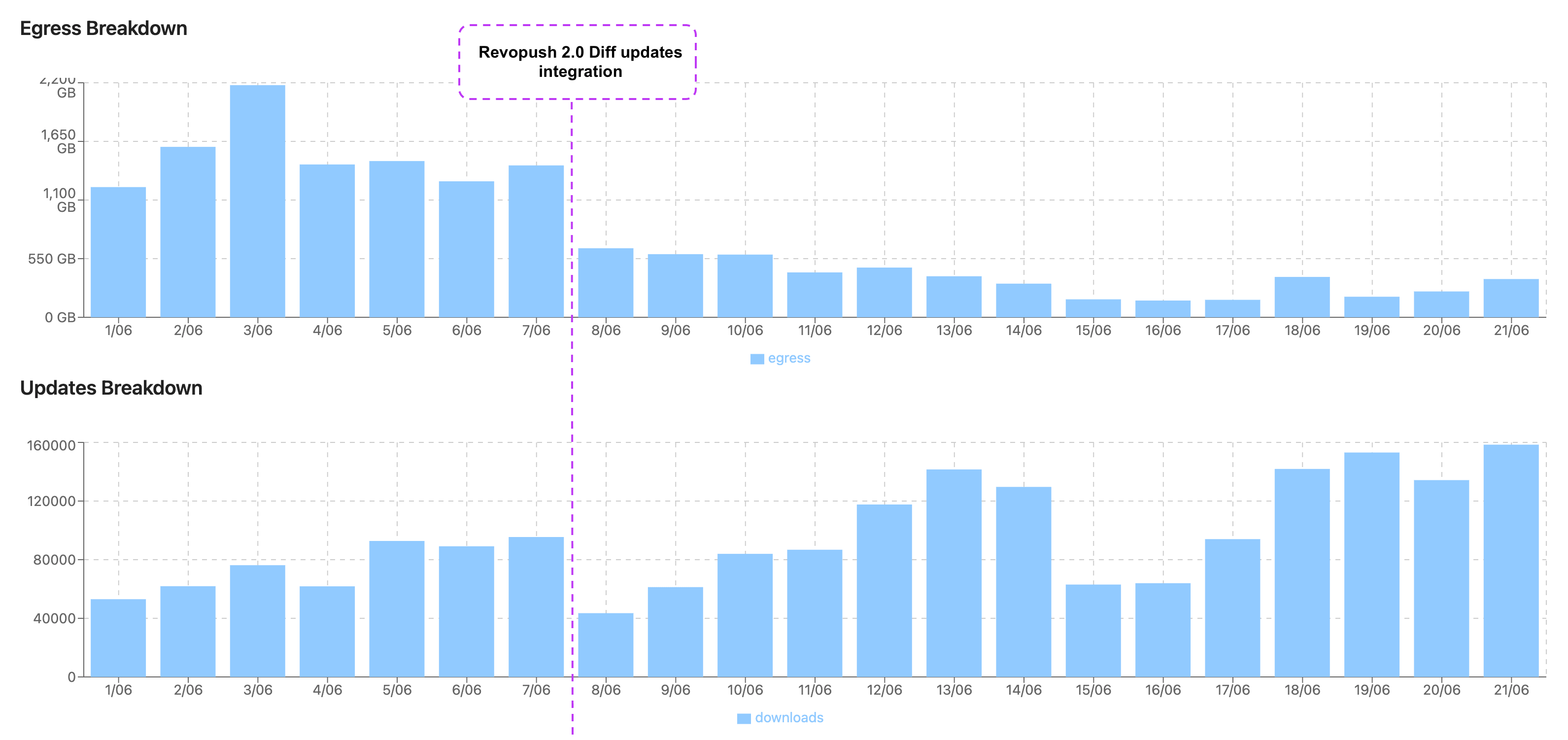
With Revopush, users do not need to download a full OTA bundle just to establish the first patch baseline. A small fix published immediately after a store release can already be delivered as a small diff.
This is useful when:
- a new native version has just reached the stores
- the JavaScript bundle is large
- the first hotfix must reach users on weak or metered connections
- many users install the app after each native release
- OTA bandwidth is a meaningful part of the operating cost
Read the technical flow in Revopush Diff Updates and see measured payloads in our React Native OTA binary diff case study.
Migration model
Revopush is designed for teams that want to preserve a CodePush-style integration and release workflow. The Revopush SDK is a maintained successor to the Microsoft React Native CodePush client, and the CLI keeps familiar CodePush concepts such as applications, deployments, and release-react.
Stallion provides its own SDK and release model. Its official migration guide removes the CodePush package, installs react-native-stallion, adds Stallion project credentials, wraps the app with withStallion(), and publishes bundles with the Stallion CLI.
Both are valid migration paths. Revopush involves less conceptual change when compatibility with an existing CodePush workflow is the priority. See the complete App Center CodePush migration guide.
Pricing and product fit
Stallion has the larger free allowance: its public free plan includes 10K MAU and 50 GB of monthly download bandwidth. That makes it attractive for prototypes and smaller apps that fit inside those limits.
Revopush has the lower paid entry point: the Startup plan is $25/month for 50K MAU. Revopush also prices egress separately, while Stallion packages a larger bandwidth allowance into its Pro plan.
Compare total cost using your actual MAU, release frequency, full bundle size, and expected patch coverage. A plan with more included bandwidth is useful; avoiding a full first OTA download can also remove a large traffic event every time you ship a new native version.
Choosing between Revopush and Stallion
Choose Revopush when you want:
- diff updates beginning with the first OTA release
- a CodePush-compatible SDK and migration path
- a lower paid entry point
- managed OTA delivery, analytics, CI/CD integrations, and team workflows
- React Native CLI and Expo support without moving to a different OTA model
Consider Stallion when you prefer:
- its larger free MAU and bandwidth allowance
- the Stallion SDK, bucket, testing, and promotion workflow
- its packaged Pro bandwidth allocation
- its enterprise or on-premise procurement options
For a wider view of managed, self-hosted, and Expo-based options, see the complete App Center CodePush alternatives for React Native.